
Why Do Portland's Most Beautiful Smart Homes Still Have Wi-Fi Dead Zones?
Explore the Problem Nobody Budgets for and Discover Its Solution
Walk through a new construction home in Bethany or a century-old craftsman in Alameda, and you'll find the same blind spot: a network that was never sized for the technology-rich home it's running.
Builder-grade tech packages will offer a router the same way it offers a doorbell: as a checkbox item. Then the homeowner adds lighting control, a security platform, four streaming devices, and a home office, and they're left wondering why a $150,000 technology package feels unreliable.
The network isn't a to-do list detail. It's the infrastructure that everything else in a modern connected home depends on, and in a market like Portland, it's carrying more weight than most people realize. Keep reading to learn how to overcome spotty network issues with strategic network design by Encore Audio Video, your local tech integration specialist.
MORE ON SMART HOMES: What’s the Invisible Smart Home Luxury Hiding in Plain Sight?
Why Are Portland Homes Especially Hard on Wi-Fi?
Two very different types of housing exist in this market, creating the same headache from opposite directions:
- Older Portland homes fight the signal itself. Neighborhoods like historic Irvington, Eastmoreland, and Laurelhurst are full of early-1900s construction with plaster-and-lath walls and, in some cases, wire mesh underneath the plaster. That construction was built to last, and it has, but it's remarkably good at absorbing Wi-Fi signals before they reach the next room. Expecting a single router to do the intense work a smart home demands in homes like these just won’t work.
- Newer builds in Bethany, West Linn, and Happy Valley fight scale instead. These homes are larger, often multi-story, and may include builder technology packages that come with a consumer-grade router sized for a starter home. A smart home running lighting, shades, cameras, and whole-home audio across 4,000+ square feet requires more intentional network design. The dead zones show up in the primary suite, the bonus room, the detached garage, and anywhere far enough from the one poor router trying to cover it all.
The homes are different, and the resulting coverage issues are the same: a home network that can't keep up with homeowners’ needs.
How Many Devices Is Your Router Actually Handling?
The answer is higher than most people initially guess. Phones, tablets, laptops, smart TVs, thermostats, doorbell cameras, security sensors, smartwatches, and streaming boxes are commonplace. A typical household runs 20 to 30 devices on a regular day, and even more if you invite friends over.
During the holidays, when out-of-town family shows up with their own phones and laptops, that number spikes further, right when the house is fullest, and no one’s in the mood to troubleshoot Wi-Fi.
A builder-grade router just gets slower in this scenario, but a professionally engineered network offers real headroom to absorb the surge without anyone noticing.
Does Every Device Need the Same Priority?
No, and treating them that way is where many "slow Wi-Fi" complaints begin. A well-designed network gives different traffic different priorities, so a video call in the home office isn't competing with a security camera feed or a kid's game console for the same bandwidth.
For homes running Control4 smart home automation, this matters even more: lighting scenes, shades, and whole-home audio need to respond the instant a button is pressed, not a beat later, and that responsiveness depends entirely on a stable connection.
Wired, Wireless, or Both?
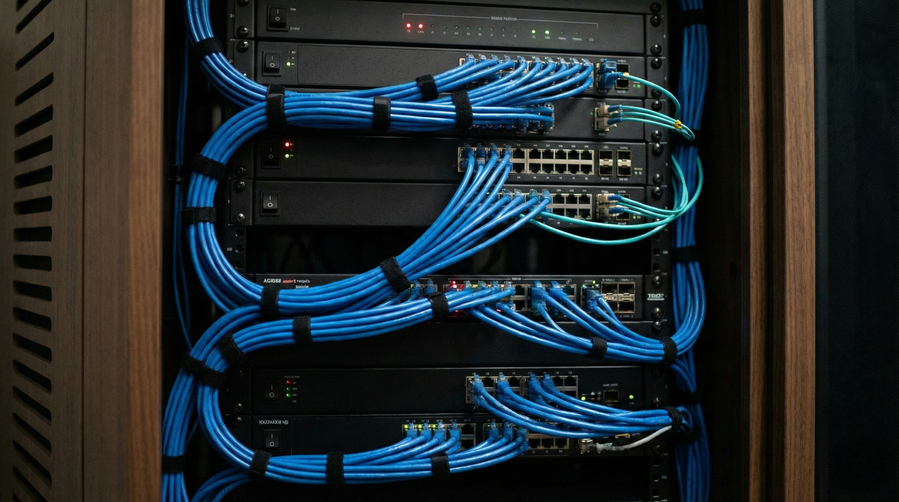
Both. The strongest networks in larger and older homes alike aren't purely wireless. Wired connections carry the heavy traffic required of streaming and security feeds, while Wi-Fi handles anything that moves around the house.
A network built around both wired and wireless connectivity delivers even, secure coverage from a home theater in the basement to the patio theater during a cookout, instead of leaving one end of the house to fend for itself.
Better Networking Standards Elevate Luxury Technology
A home's technology is only as reliable as the network beneath it. In a market with as much housing variety as Portland's, that network needs to be designed for the specific home and family it serves, not based on a one-size-fits-all solution.
Request a network assessment today, and let’s review what’s working and what’s not with your home’s connectivity.